


In October 2019, Mindfield Biosystems recorded the eSense Pulse and the clinical ECG monitor Faros 180 simultaneously on the same subject and compared the RR intervals of both devices. The beat-to-beat course matches. In this recording, the eSense Pulse RR intervals were on average about 2.2% longer than those of the Faros 180.
Methodology
All measurements were taken on 17 October 2019 on the same subject. Both devices were worn simultaneously as chest strap ECGs. The eSense Pulse was recorded with eSense App 4.4.7 on an iPad (iOS 13.1.2). The Faros 180 data were analysed in Kubios HRV Premium (release of August 2019).
| Property | eSense Pulse | Faros 180 |
|---|---|---|
| Manufacturer | Mindfield Biosystems | Bittium (formerly Mega Electronics) |
| Measurement method | ECG (1-channel) at the chest | ECG (1-channel) at the chest |
| Application | Mobile HRV biofeedback | Clinical long-term ECG recording |
| Certification | CE | CE, FDA |
| Sampling rate | 500 Hz ECG | 1000 Hz ECG |
| Price range | €150 | €1,069 |
Measurement Setup
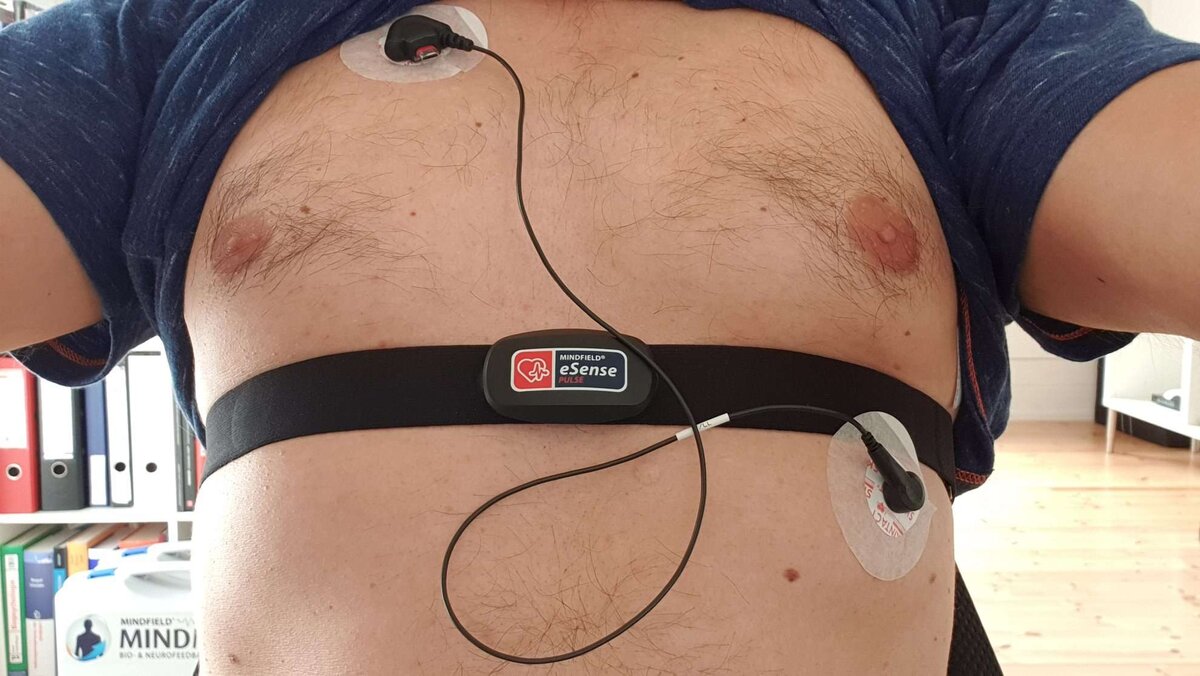
Three 10-minute measurements were conducted. Measurements 2 and 3 have been preserved; the data of measurement 1 are no longer available. The RR intervals from both devices were overlaid in Excel.
Results
Measurement 2: 10 minutes, quiet sitting
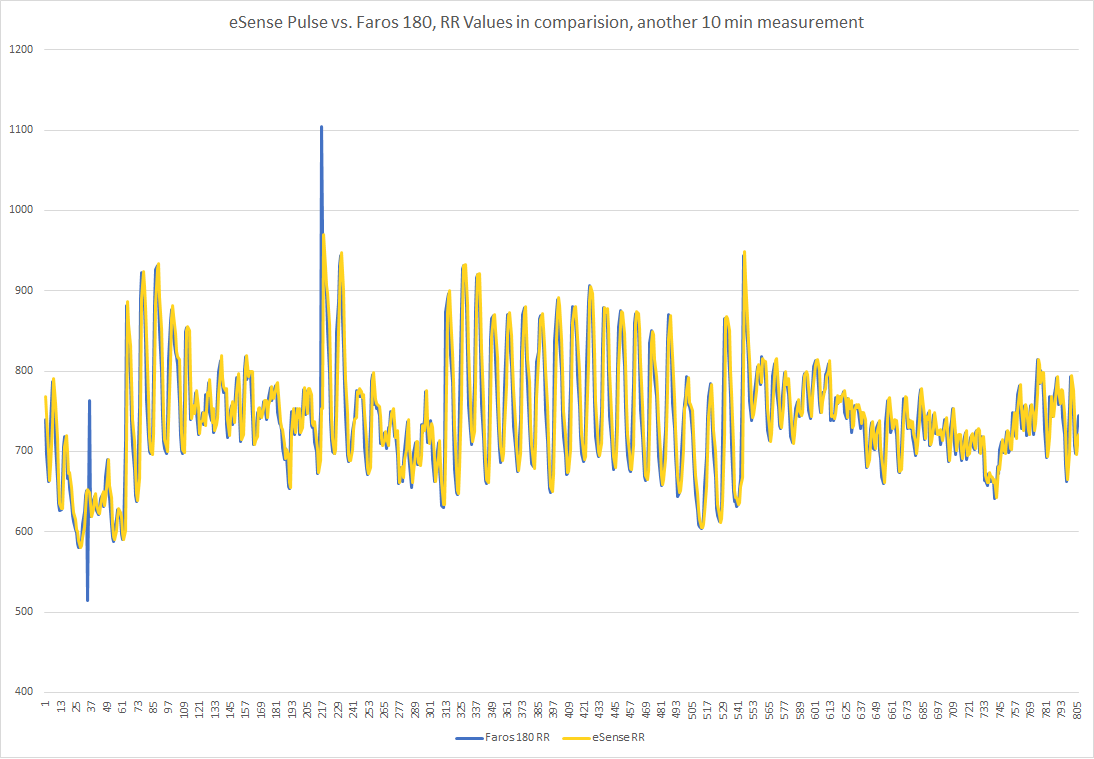
Both curves show the same heart rate fluctuations in the same temporal sequence. The eSense Pulse RR intervals are longer on average: 759.3 ms versus 742.9 ms for the Faros 180. Analysing both RR series in Kubios gave SDNN 56.0 ms and RMSSD 33.7 ms for the eSense Pulse, and SDNN 56.2 ms and RMSSD 36.5 ms for the Faros 180.
Measurement 3: 10 minutes, shown with correction factor 1.02
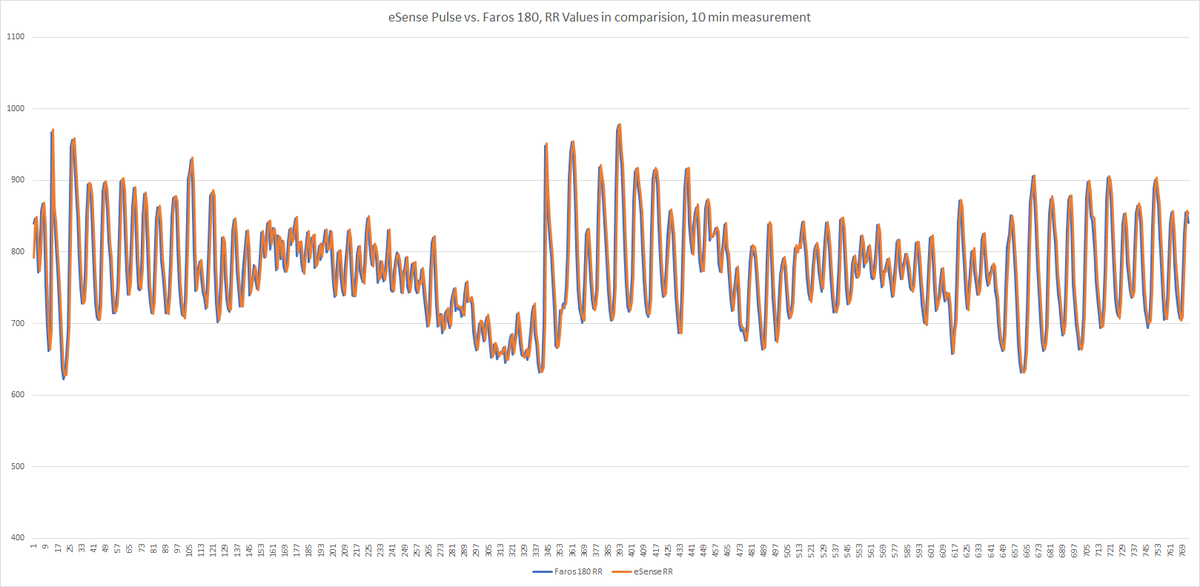
Here, too, both curves follow the same course beat by beat. Both devices recorded 773 beats. The mean RR interval was 792.4 ms for the eSense Pulse and 774.9 ms for the Faros 180. For the chart, the curves were scaled by a factor of 1.02 so that they lie directly on top of each other.
About the Correction Factor
In both measurements, the eSense Pulse RR intervals are on average about 2.2% longer than those of the Faros 180. The offset is constant across the entire recording, while the beat-to-beat course matches. The time scale of the eSense recording was therefore offset by a constant factor relative to the reference device. The chart for measurement 3 shows the scaled curves; the raw data in the download are uncorrected. The measurement has not yet been repeated with the current eSense App.
Conclusion
Assessment
In its beat-to-beat course, the RR interval recording of the eSense Pulse is very close to the readings of the clinical reference device Faros 180. In this recording, the mean values differed by about 2.2% (see above).
The informative value is limited:
- one subject, two preserved measurements of 10 minutes each
- no paired measurements under physical load
- recorded in 2019 with the eSense App of that time, not repeated with the current app
- no statistical agreement analysis (such as Bland-Altman)
The comparison says nothing about suitability for medical diagnostics. The eSense Pulse is intended for HRV biofeedback training.
The eSense Pulse is also used in independent scientific studies on heart rate variability, including at the University Medical Center Mainz and Virginia Commonwealth University.
Downloads
Download the raw data of the preserved measurements:
- Raw data of measurements 2 and 3 (CSV + EDF, ZIP) — eSense Pulse RR intervals (uncorrected), Faros 180 ECG (EDF) and Kubios analysis
Note
These comparison measurements were conducted by Mindfield Biosystems in their own laboratory. Both devices — eSense Pulse and Faros 180 — are available in the Mindfield Shop.